|
Standard F.C.I. N°37 / 22.01.1999 / (TRANSLATION : Club Portugais de Caniculture et Dr. J.-M. Paschoud). PORTUGUESE WATER DOG (Cao de Agua Portugues). ORIGINE : of the portuguese water dog : Portugal. DATE OF PUBLICATION OF THE ORIGINAL VALID STANDARD : 09.12.1966. 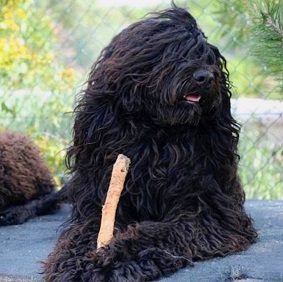
USE of the portuguese water dog : The portuguese water dog is a swimmer and extraordinary plunger. This dog is the companion inseparable from the fishermen to whom it returns d' innumerable services not only with the fishing season, but also as guard and defender of their boats and their goods. When its Master fishes, it follows work attentively and jumps spontaneously to the sea and plunges even if necessary to catch up with and bring back fish who had escaped. When a net to be torn or when a mooring rope is detached, it acts in the same way. This dog is also employed like liaison officer between the boat and the shore or vice versa, even when the distance is considerable. CLASSIFICATION F.C.I. : Group 8, retrievers, Flushing Dogs, water do. Section 3 water dog. Without working trial. A BRIEF HISTORICAL OVERVIEW OF THE PORTUGUESE WATER DOG This very ancient Portuguese breed is closely related to the French Barbet and the Spanish Water Dog. The Portuguese Water Dog originated in the Algarve province, in the extreme south of Portugal. It was the traditional companion of fishermen and sailors, serving as a messenger dog to carry objects or messages from one boat to another or from a boat to the shore. It also worked as a retriever, fetching anything that fell overboard, such as ropes or fish that had escaped from the nets. This sturdy and intelligent dog therefore served as a messenger between boats, helping fishermen gather their equipment, retrieve damaged fishing nets, and even herd schools of fish. It was regarded as a full-fledged member of the crew. Outside the fishing season, the dog could also be used to herd livestock. This made the Portuguese Water Dog a remarkably versatile working dog, both in and out of the water. This medium-sized breed has an obedient temperament and is extremely loyal to its owner. It is also highly resistant to fatigue and performs its work with ease and great enthusiasm. It is a very energetic dog that loves to stay active ! Bull-baiting spread throughout Europe and was practiced for more than six centuries. Although the Portuguese Water Dog was still quite popular at the beginning of the last century, it became increasingly rare during the first decades of the 20th century. The breed had largely lost its original purpose, as modern fishing methods had replaced the traditional techniques that had once required its unique skills. Although still very popular at the beginning of the last century, the Portuguese Water Dog became increasingly rare during the first decades of the 20th century. It had, in fact, lost its original purpose, as modern fishing techniques had replaced the traditional methods for which the breed had been developed. However, by the early 1930s, the owner of a large fleet of sailing vessels, Vasco Bensaude, who was also a breeder of Clumber Spaniels, Cocker Spaniels and Irish Wolfhounds, undertook the task of preserving the Portuguese Water Dog. Around 1933, he drew up the breed standard. At his Algarborium Kennel, the first litter from Leão and Dina to be registered in the Portuguese Stud Book (LOP) was born in 1937. Leão became the prototype on which the breed standard was based. He was one of the very few dogs still performing their traditional duties for local fishermen, who at first had refused to sell him, although they eventually agreed to do so. In 1938, Professor Fernandes Marques published the first comprehensive report on the "Water Dog" breed, and its official breed standard was published by the CCP (Clube dos Caçadores Portugueses), the Portuguese Hunters' Club, in its canine breeding section under the name "Cão de Água Português". President of the CCP: Daniel da Silva Lane; Secretary General: Vasco Bensaude. By 1955, a total of 100 Portuguese Water Dogs had been registered under the "Algarborium" prefix in the Portuguese Stud Book (LOP). All of them carried the bloodlines of Leão. However, there was another passionate advocate of the Portuguese Water Dog: the veterinarian Dr. Cabral, who set himself the goal of breeding Portuguese Water Dogs without using the Algarborium bloodlines. He founded his breeding program with a dog he had found, named Silves, and established his own Alvalade line. While the Algarborium dogs were being exported to the Americas, and following the death of Vasco Bensaude in 1967 they survived only at Al-Gharb Kennel, owned by Conchita Cintrón, the heir to Algarborium Kennel in Portugal, the Alvalade dogs remained in Portugal and have continued to be preserved there to the present day. When Conchita Cintrón was forced to leave her estates in Castelo Branco, Portugal, with her six children during the 1974 Revolution, the last Algarborium dogs disappeared from Portugal with her. Nevertheless, their descendants continued to be bred in the United States in ever-increasing numbers and remain well established there to this day, where they have also gained considerable fame. Portugal, however, still laments this loss, as the Alvalade dogs have never matched their Algarborium counterparts in either numbers or overall quality. Carla Molinari, who served for many years as president of the CPC (Portuguese Dog Breeders' Club), became the heir to the Alvalade bloodline. The Portuguese Water Dog came into her possession indirectly when Dr. Cabral, during the difficult years of the Revolution, used her Vale Negro Kennel to house his own dogs as a matter of survival. In return, he promised to compensate her with Portuguese Water Dogs. However, he did not keep his promise and ultimately left her with only a single breeding pair, while shipping all of the remaining dogs to the Americas. This marked the beginning of the well-known crisis during which the Portuguese Water Dog came close to disappearing forever. The Algarve region was no longer able to supply breeding stock, as local fishermen were experiencing severe economic hardship and could no longer afford to keep dogs. Through the dedication of Carla Molinari, together with a handful of committed Portuguese breeders, the Portuguese Water Dog was ultimately preserved, although only by accepting numerous compromises in the breeding program. Today, the Portuguese Water Dog possesses a highly promising genetic foundation, and the Cão de Água Português has become a magnificent breed that stands out in dog shows throughout the world. GENERAL APPEARANCE of the portuguese water dog : The portuguese water dog has average proportions, a figure slightly convex to straight, kind of Braccoid. Harmonious in its proportions, the Portuguese Water Dog is well balanced, robust and very muscular. Muscle development due to frequent exercises swimming is remarkable. COMPORTEMENT of the portuguese water dog / CARACTERE of the portuguese water dog : The Portuguese Water Dog is an impetuous animal, willful, proud, pugnacious, sober and resistant to fatigue. His expression is stern, his gaze is penetrating and awake it has excellent views and a good nose. In exceptional intelligence, he understands and obeys easily and enjoy all the orders of his master. The Portuguese Water Dog is an adorable companion. HEAD of the portuguese water dog : Well proportioned, strong and broad. CRANIAL REGION of the portuguese water dog : Skull : Seen profile, it is slightly longer than the muzzle ; it is curved more marked in the region of the occiput and the occipital crest is so pronounced. Seen from the front, the parietal are curved and have a slight depression at mid-height. The frontal furrow extends sagittally up to two thirds of the parietal ; brows are prominent. Stop : Well defined and is positioned slightly further back than the inner corner of the eyes. FACIAL REGION of the portuguese water dog : Nose : Large, with well-opened nostrils and finely pigmented. Black in dogs with black, white, or black-and-white coats; in dogs with brown coats, the color of the nose corresponds to the color of the coat. The nose of the Portuguese Water Dog must never be flesh-colored. Muzzle : Narrower near the nose than at the base. Lips : Thick, especially in front; the corners of the mouth are not apparent. The mucous membranes (palate, underside of the tongue, and gums) have a strongly pronounced black pigmentation. Jaws / Teeth : Strong jaws, with a normal bite. Good teeth, not visible when the mouth is closed; canines strong and well developed. Eyes : Medium-sized, set on the same plane as the skin, rounded, well spaced apart, and slightly oblique. The iris is black or brown. The eyelids, made of fine skin, are edged with black. The conjunctiva is not visible. Ears : Set higher than the eye line, they are carried close to the head with the rear edge slightly separated from the skull; thin and heart-shaped. Their tips must not extend beyond the throat line. NECK of the portuguese water dog : Straight, short, rounded, muscular, uncluttered and a proud carriage ; Release smooth neck, no collar or dewlap. BODY of the portuguese water dog : Withers : Wide and not prominent. Back : Straight, short, broad and well muscled. Kidney : Short and well connected to the croup. Croup : Well shaped and slightly inclined ; peak symmetrical hips and barely noticeable. Chest : Broad and deep, reaching to the elbows, long and well sprung ribs, giving a good respiratory efficiency. Belly : From low volume and elegant port. TAIL of the portuguese water dog : Uncut. Thick at the root, it tapers to its end. Set at medium height, length must not exceed the hock. When the dog is alert, the tail gate wrapped in a ring shape, it should not exceed the middle of the kidney. The tail of the Portuguese Water Dog is a valuable aid for swimming and snorkeling. MEMBERS of the portuguese water dog : Aplomb : Overhangs fore and hind limbs are correct, we assume slightly bent metacarpals and metatarsals slightly slanted forward. FORELIMBS of the portuguese water dog : Strong and straight. Shoulders : The shoulder blades, viewed from the side and from above, are well sloped and have well-developed musculature. Upper arm : Strong and of medium length; parallel to the median line of the body. Forearm : Long and strongly muscled. Carpus : The bone structure is strongly developed, wider when viewed from the front than from the side. Metacarpus : Long and strong. Forefeet : Round and flat, with toes that are neither too arched nor too long. The interdigital membrane, which extends to the tips of the toes, is of loose texture and well covered with long hair. The nails should preferably be black, but depending on the coat color, white, striped, or brown nails are accepted. The nails do not touch the ground. The central pad is hard and thick; the other pads are of normal thickness. HINDQUARTERS of the portuguese water dog : Rights and very muscular. Bottom: Long and well rounded. Thigh: Strong, of medium length, very muscular. Grasset: He moves parallel to the median plane of the body. Legs: Long and strongly muscled remains parallel to the median plane of the body. Although inclined from front to rear. Tendons and ligaments are structurally sound. Hock: Strong. Hock: Long, without dewclaws. Hind feet: In all respects similar to the forefoot. REAR LIMBS of the portuguese water dog : Gaits emerged, not short, light and cadenced trot, energetic gallop. FUR of the portuguese water dog : The whole body is covered extensively resistant hair. No undercoat. There are two variety of long hair. wavy or curly. The other shorter is frizzy hair. Long hair is a bit glossy and smooth consistency, the shorter coat is dense, dull and form wicks cylinders. Except in the armpits and in the folds of the groin, the hair is evenly distributed throughout the body. The hair on the head as a kind of tuft of hair wavy or frizzy hair in the second variety. In the long haired variety, the hair is more pronounced ear length. COLOR of the portuguese water dog : The coat of the portuguese water dog is plain or composed, the United dresses are white, black or brown in their different nuances ; dresses are composed of mixtures of black or brown with white. A white dress in the Portuguese Water Dog is not a sign of albinism as the nose, the edges of the eyelids and oral mucosa are pigmented black. In Portuguese water dogs the black dress, white or black and white, the skin is slightly blue. When the hair becomes very long, one mows these dogs from behind until with half-length like their muzzle and their tail in their leaving however a pompom at the end of the tail. This form of partial cutting is characteristic. SIZE and WEIGHT of the portuguese water dog : Height at withers for portuguese water dog males 50 to 57 cm, 54 cm ideal size. For females: 43 to 52 cm, 46 cm ideal size. Males weight between 19 and 25 kg. Females between 16 and 22 kg. MESURES : Males or females, Head: skull length 12.5 cm - 11 cm ; Width of skull 11 cm - 9.5 cm ; Chamfer length 9 cm - 7 cm ; Chest girth 61 cm - 56 cm ; width chest 15 cm - 13 cm ; height chest 21 cm - 18 cm ; Topline trunk length 45 cm - 40 cm ; Trunk width 11.5 cm - 10 cm ; body length 51 cm - 45 cm ; length tail 32 cm - 27 cm ; height at withers 54 cm - 46 cm ; Height from ground to elbow 29 cm - 25 cm ; Height at the croup 52 cm - 46 cm. DEFECTS of the portuguese water dog : Any deviation from the foregoing points should be considered a fault. Default will be penalized according to its gravity. ELIMINATING DEFECTS of the portuguese water dog : Long head, too narrow, flat, pointed. Truffle partially or totally invaded by the miser. Muzzle funnel-shaped or too sharp. Jaw overshot or undershot bite. Wall eyes, clear, shape and unequal size, highly prominent or too deep. Ears poorly attached, too big, too short, pleated. Docked, rudimentary shower, Tailless, heavy, hanging right at work or scope. Dewclaws metatarsal. Albinism dress, different dress standards set by the standard. Size gigantism, dwarfism. Congenital or acquired deafness. SCALE POINTS in the portuguese water dog : Male and female head port, skull, ears, eyes, nose, mouth, muzzle, nostrils : 20 Neck, withers, shoulders, forequarters : 07 Chest, kidney, lines above and below: 15 Croup, pelvis, back-hand : 13 Feet, toes, nails : 10 Tail, Port, shape, base : 55 Dress, hair texture, color, density : 55 General Appearance, harmony of all, pace, size, sexual character s: 25 Total : 200. N.B. : Male animals should have two apparently normal testicles fully descended into the scrotum. |